The Hidden Costs of ‘Good Enough’
When I started designing websites and writing web copy in the early 2010s for my father’s accountancy practice, websites were often little more than digital brochures: static and image-heavy. Back then, many businesses still felt simply having an online presence was enough. But that era is long gone. Your website is now one of the main places prospects and buyers go to, and AI tools may draw on when looking for information or products/service recommendations.
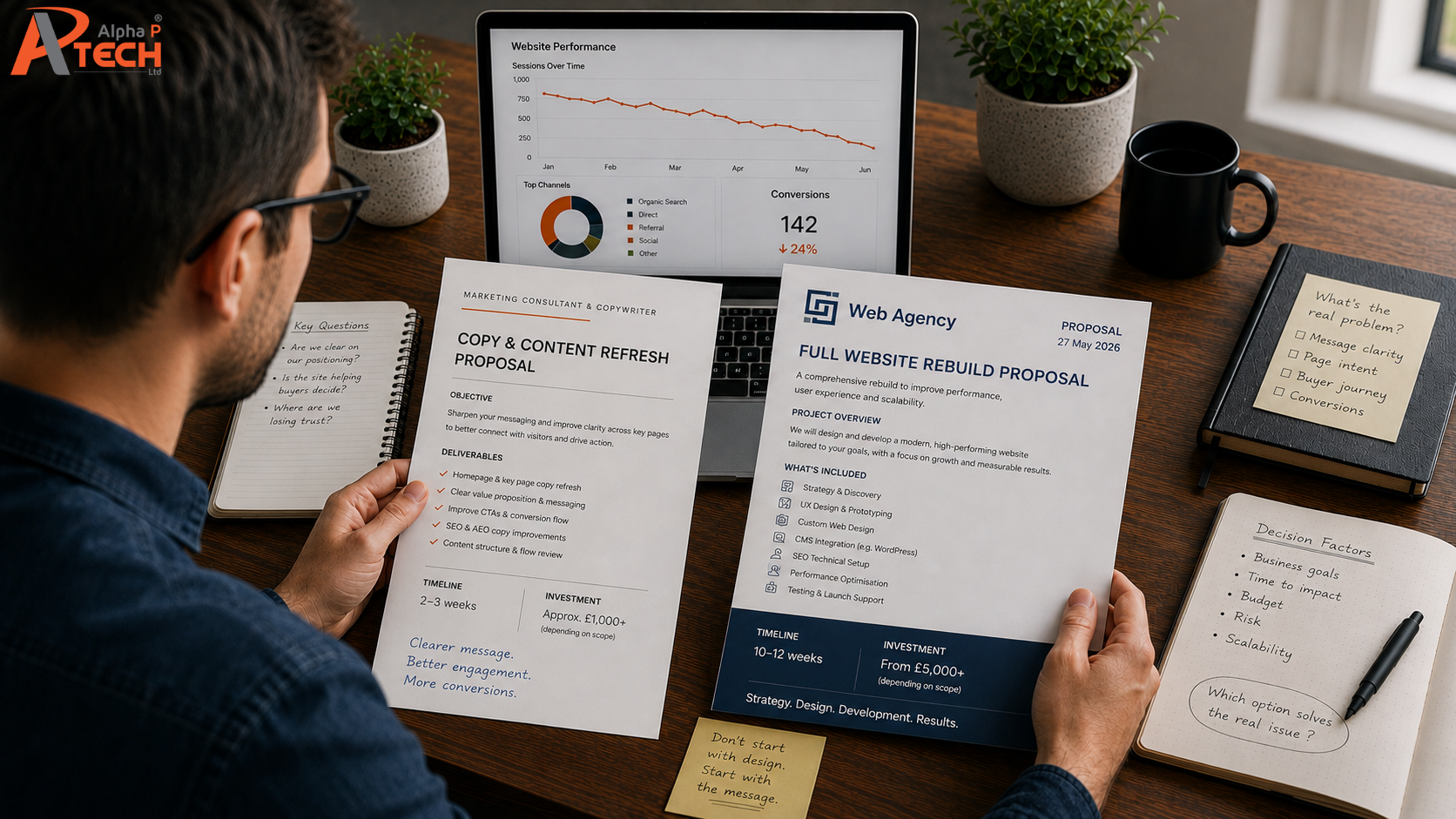
However, as a Chartered Marketer who’s worked with businesses of all sizes, I’ve found that almost all teams and business owners reach a stage where their website is either underperforming in some way (be that generating leads, signups, or purchases) or is not strong enough to support the next stage of growth. I often hear teams say they’re getting traffic but struggling with conversions, “the tone isn’t right anymore,” or ask, “is our positioning clear?” and “when is it time for a full redesign instead of just making small updates”?
Looking at some of the most recurring issues and questions my team and I see across website copywriting projects, client conversations, and wider research from 100+ recent forum discussions, this article will help guide you on whether the solution is a full rebuild, updating the copy or optimising just a couple of pages.[1]
Clarify the Site’s Purpose and Audience Before You Decide
Before you decide whether to optimise or rebuild your website, take a step back and ask two very important questions: Who is your target audience, and what’s the buyer’s journey?
When a site or landing page tries to speak to everyone, it often ends up speaking to no one because the positioning and copy become so broad that they mean very little to any given person. This is why we say a good landing page is user-focused.
If your main users are buyers, understanding where they came from, the problems they’re looking to solve, the questions they’re looking to answer, and what their next step is will help your site build relevance, trust and become easier to choose.
If you target various sectors, ICPs, partners or other stakeholders, ensure you have dedicated pages or sections that speak to each of them, rather than trying to fit them all into one funnel.
Once you know this, determining your positioning, site structure, calls-to-action and website copy becomes much easier. You’ll also be able to see where your current site falls short and whether you need to optimise a few pages or take on a bigger project.
When to Optimise Your B2B Website
When we see businesses that have a good overall message and an offer that resonates with their target audience, but are saying “not sure where to put each piece of content”, “how to word it effectively” or “most get to the landing page, but few to the demo”, this points towards optimising a few pages rather than rebuilding entirely.
In these cases, the copy, page structure and overall user experience need fine-tuning rather than a deeper strategy issue involving reworking the whole site.
The red flags we notice that usually point towards optimising are:
- Pages get traffic, but visitors leave quickly without buying or engaging.
- Or they go from page to page without taking action or enquiring.
- Your offers are clear to your team, but not to first-time visitors.
- The site looks professional, but you wonder if it feels generic, templated or AI-written.
- Your call-to-action buttons say “learn more” and aren’t compelling visitors to click.
- The site is easy to use and navigate on desktop, but more difficult or ‘clunky’ on mobile.
- Your budget is limited or you have a tight deadline to work on the site.
To start, we’d solve these issues by:
- Reviewing your top three pages that bring the most traffic, are service pages, or hold key information. Don’t try to redo all 20 at once!
- Check the page structure. Do the sections answer buyers’ main questions, build trust or help move them closer to a decision?
- Rework the headlines, page flow and calls to action so it’s clear to visitors, search engines and AI tools.
- Ensure your existing URLs, internal links and page relationships stay intact, to protect SEO.
This isn’t about just “changing a few words”. It’s about ensuring each page gives the right information to visitors at the right stage in their buyer journey, in a way that builds trust and moves them closer to taking action.
When to Rebuild a B2B Website
As businesses grow, add new offerings, or restructure, updating the copy and CTAs might not be enough to ensure your site can perform in the future. When we’re told “the tone isn’t right anymore”, “I want the whole thing to be restructured differently” or “we’ve added quite a few pages over time and the structure is starting to feel a bit messy”, rebuilding the site may be the better move.
The red flags we notice that usually point towards rebuilding are:
- You’ve changed the copy several times, but visitors still aren’t converting.
- You’re questioning if your “messaging actually hits the mark” or “positioning is clear?”
- You’ve added new pages and content that aren’t being used or converting.
- Your current design or CMS limits what your team can easily update, test, or build
- You are going through a rebrand, repositioning, or restructuring and want a fresh start
This usually means the issue isn’t just the wording on the page. The website’s structure, message, and buyer journey may no longer fit where the business is now or where it’s growing. When looking to rebuild a website, we start by:
- Being very clear on who your audience is for each service, and what your brand positioning and voice are.
- Deciding on a sitemap based on how customers actually navigate the buying process, not on standard templates or service categories. Not all businesses need the home, about, services, contact structure.
- Before writing copy, give each page and section a specific job relevant to your visitors’ (and buyers’) journey.
- Protect your SEO value by using redirects, improving internal linking, and developing a purposeful content structure.
- Design the site in a way that allows your team to easily update or test new changes in the future.
This makes sure your site not only looks better, but also makes your business, purpose and offers clearer to the right audience, while supporting your wider marketing efforts.
💡 Tip: Your website doesn’t need to look broken to be holding back growth. Small gaps in clarity, trust or structure can quietly stop some of the right people from taking the next step – Alexandros Papantoniou, Chartered Marketer & Founder
What comes first, the Copy or the Design?
The best results come when website copy is built around the buyer rather than the design. This goes for page rewrites and full site rebuilds. First, get clear on what buyers need to understand, believe and trust before they take action. Then let that shape the page structure, layout decisions and navigation flow.
Too often, businesses select a pre-built template, their existing sitemap, an AI-generated or competitor-based structure and then try to squeeze their story into it. This leads to a website that’s unclear, generic or indistinct to your own audience.
When working on website projects, we start by creating a structure based around your buyer’s current behaviour, then work with web designers and developers to build a site that delivers the right message in the right place.
This is where website copywriting and design work together to support your site and wider marketing strategy.
SEO/AEO Implications You Can’t Ignore
A key consideration when looking to update certain pages or the whole website is SEO and AI search visibility. Keeping the parts that are working well for your visibility, and improving the parts that aren’t, can help you avoid losing valuable traffic whilst generating awareness with new buyers.
Some sites we see that feel dated but still rank for important keywords, or have messy structures but still convert decently, may just need to strengthen the message, structure, and search visibility signals rather than starting from scratch.
Similarly, improving poor search visibility may require optimising key pages with new positioning, content, internal links and conversion paths instead.
In other cases, we find the issue is a mix of SEO, technical, and user-experience-related factors. Either visitors are unable to take action due to a technical button or form error, or are converting successfully, but analytics and reports aren’t counting them. These types of issues can lead to poor optimisation or fixing the wrong things.
When a rebuild is necessary, plan for search visibility before design starts. Map old URLs to new pages, preserve useful content and page intent, set up redirects, protect internal links and check your content is visible and easy for AI search tools and LLMs to understand and cite.
With a growing number of people using AI tools to search for information and compare solutions, your website needs to be written and structured not only for traditional search, but also AI search tools. Any site refresh or rebuild should take this into consideration and optimise for both buyers and search visibility.
What to Prioritise (Either Way)
When you feel your website needs optimising or rebuilding entirely, we’d usually start with a content audit of the pages closest to the buying decision, such as service pages, landing pages and any page already bringing in useful traffic. Whether you handle this internally or use website copywriting services, certain elements should always take priority if you want the site to drive meaningful results.
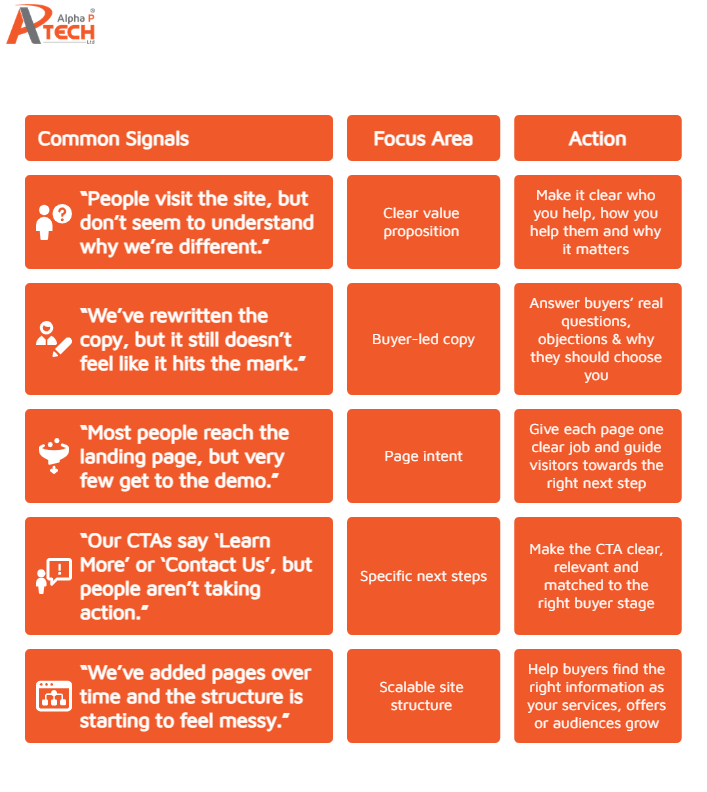
- A clear value proposition. Ask yourself if a first-time visitor can understand who you help, how you help them, and why it matters within seconds of landing on your site.
- Copy that reflects how buyers make decisions. Don’t just describe what you sell and the benefits (e.g. payroll services that save you time and keep you compliant). Answer buyers’ key questions whilst showing what makes you unique and worth choosing (e.g. payroll support built for growing tech startups).
- Each page should have a clear job. Avoid broad, unfocused content that tries to do everything or speak to everyone at once. Instead, have dedicated pages for different offers, ads or ICPs.
- Calls to action with specific next steps. Go beyond vague “Contact Us” or “Learn More” buttons by making it clear whether the buyer’s next step is booking a discovery call, downloading a resource or something else.
- Logical site structure that can scale. Build page structures that make it easy for buyers to find answers, build trust and take the next step. Use adaptable sections to make it easier to update as your services evolve.
Above all, your website must reflect how modern buyers actually make decisions. If your site hasn’t been updated in a long time, or no longer reflects buyers’ current problems, questions or behaviours, even an aesthetically and technically sound website may struggle.
Conclusion: Fix the Right Layer First
Whether you decide to optimise or rebuild, the main lesson is the same: do not start with the surface-level fix.
Across the website and landing page issues we reviewed, businesses often focused on the visible problem first. The design looks dated. The CTA feels weak. The page is not converting. The site structure feels messy. But the real issue is often deeper: unclear positioning, weak message flow, missing buyer confidence, poor page intent or a website that no longer reflects how the business has grown.
That does not always mean starting again. Sometimes a focused copy refresh, content audit or page optimisation is enough. Other times, the site needs to be rebuilt around a clearer structure, stronger message and better buyer journey.
The better question is not simply “do I need a new website?” It’s: is this site still helping the right people understand, trust and choose us?
If you are unsure where to begin, we can help you diagnose what needs changing before you spend time or budget in the wrong place. Our website and funnel support shows in more detail how we can help you improve your copy, structure and strategy behind your website.
Frequently Asked Questions
How often should a business update its website?
There is no fixed rule that says a business should update its website every three, five or seven years. The better question is whether the site still reflects your offer, audience, positioning and buyer journey. If your services have changed, your pages are not converting, the structure feels messy, or buyers can no longer quickly understand why they should choose you, it may be time to update the site regardless of its age.
Should I rebuild my website from scratch or update the existing one?
Update the existing site if the overall positioning, structure and platform still work, but key pages need clearer copy, stronger CTAs, better flow or improved SEO and AI search visibility. A rebuild makes more sense when the business has outgrown the site, the structure no longer fits, the CMS limits what you can do, or the website no longer reflects your services, audience or direction of growth.
Can I improve SEO and user experience without rebuilding my website?
Yes, in many cases you can improve SEO and user experience without a full rebuild. Start with the pages already getting traffic or sitting closest to the buying decision. Review the copy, page structure, internal links, mobile experience, CTAs, form functionality and tracking. If the site’s foundations are still sound, focused optimisation can often improve visibility and conversions without the cost or disruption of starting again.
[1] This is not a formal statistical study. It is based on more than a decade’s worth of marketing experience with B2B websites, along with the recurring patterns we have seen across client conversations, projects, and 100+ recent public discussions from Reddit, Indie Hackers, UK Business Forums, and specialist website feedback forums.