

Why AI Search Has Redefined Visibility
For years, SEO was the cornerstone of digital visibility. But AI-driven search environments have changed how visibility works. Businesses can no longer rely solely on traditional keyword rankings and backlinks to be discovered online.
With the rise of AI-powered search tools, the way decision-makers find information has shifted, and content marketing has evolved as a result. Instead of prioritising keywords to rank on page one or formatting a page to be picked up by AI tools, the aim is now to ensure your brand, and the narrative behind it, is found, understood and trusted by both buyers and AI across multiple sources.
This shift places answer engine optimisation (AEO) and generative engine optimisation (GEO) at the centre of any modern content marketing strategy. For B2B firms, it raises important questions about whether your content is discoverable, credible, and drives sales momentum.
Whether you’re looking to keep your brand visible or refine your content strategy, this article will help you understand what this shift means.
From SEO to AEO: What’s The Difference?
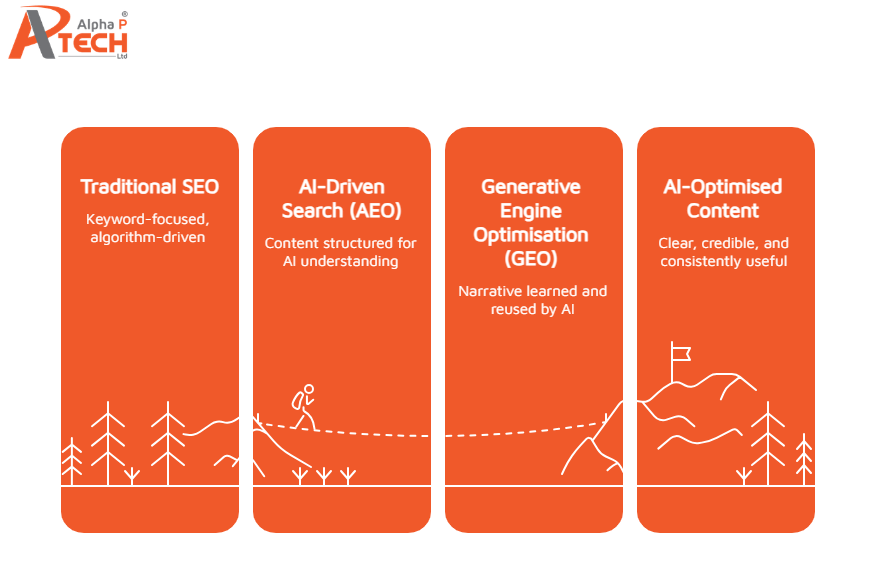
Traditional SEO relied on ranking signals such as keywords, backlinks and metadata, but AEO takes a different approach. Instead of rewarding sites that can outmanoeuvre algorithms with technical tweaks, it prioritises content that is structured in a way AI can understand and present directly to users.
You can no longer rely on keyword stuffing or large volumes of generic, AI-generated copy. The meaning and usefulness of your content matter more than ever.
AI-driven search platforms do not simply crawl and index; they interpret, evaluate and summarise. This means that if your pages do not provide clear answers or simply repeat what buyers can find elsewhere, they risk being invisible in AI-generated answers.
For B2B firms, this shift calls for a different approach to content strategy. It is no longer enough to optimise for rankings alone. The priority is to
- create resources that demonstrate expertise,
- provide direct value,
- guide buyers through the decision-making process, and
- structure content so AI can read and interpret it.
In practice, this means focusing on clarity, depth, and relevance so that your insights surface when clients and prospects turn to AI search.
From AEO to GEO: What’s Next?
While answer engine optimisation focuses on structuring content so AI tools can generate direct responses, generative engine optimisation (GEO) focuses on how your narrative is learned and reused in those answers. Instead of being about keywords or even short, structured snippets, GEO looks at:
- how your content is cited or referenced by AI-generated outputs
- whether authoritative sources carry your insights into conversational responses
- how context, tone and trust signals influence what generative engines “choose” to surface
This is why some brands appear consistently across AI-generated answers, while others rarely surface at all. You can see how this works in practice in our breakdown of real-world GEO examples.
For B2B firms, this means content must be clear, credible and consistently useful to buyers across multiple touchpoints. As AI search evolves, GEO is becoming a vital part of the future of B2B marketing.
How Do AI Search Engines Pull Content?
Rather than rely on a single optimised page on your website, AI builds a broader picture of your brand from blogs, social media, forums, PR and older content. Over time, this creates a cumulative understanding of your brand rather than a view based on a single page.
Research from Similarweb and SEMrush shows that Wikipedia, Reddit, LinkedIn and YouTube are frequently cited in LLM outputs, while Forbes, Reuters and other PR sources also feature prominently.
In other words, optimisation shouldn’t end with your company’s blog posts. It should span across the various platforms you publish content on and contribute to the narrative you want buyers to learn. In practical terms, content should be structured to answer the questions buyers are actively asking. If you’re unsure what this means for your own content, we explore in more detail what content is actually worth creating for AI search visibility.
For B2B firms, this means credibility is no longer measured only by rankings, but by how consistently your insights appear and align across the sources AI tools draw from. An approach built around GEO should therefore emphasise clarity and structured information that is useful to buyers across multiple sources.
Conclusion: Move Beyond Rankings, Towards Recognition
SEO still plays a role in how content is discovered, but it is no longer the defining factor. AI-driven search has shifted visibility away from rankings alone and towards recognition, where your insights are understood, referenced, and trusted across multiple sources. Visibility is no longer driven by isolated pieces of content, but by how your ideas are consistently expressed and reinforced over time.
For B2B firms, this changes what it means to be visible. It is no longer just about appearing on a results page, but about shaping how your expertise is interpreted and reused in the answers buyers rely on. Content now contributes to a broader picture that AI builds over time, drawing from multiple touchpoints rather than a single optimised page.
This also means content must do more than inform. It needs to help buyers move through their decision-making process, building trust, reducing uncertainty, and supporting sales momentum at each stage of the journey.
Understanding this shift is the first step. The next is knowing what to create and how to structure it so your insights are consistently surfaced, trusted, and carry buyers forward.