
TL;DR: Key Takeaways
Most B2B content plans still focus on keywords, content formats, and publishing schedules. That may keep marketing active, but it does not always improve trust, lead quality, or move buyers towards a sale. For AI search visibility, content needs to do more than rank or fill a calendar. It needs to shape what buyers and AI systems repeatedly learn about your business across search, social media, your website, and sales conversations.
At Alpha P Tech, content planning starts with the story you want the market to understand, then maps content to buyer journey stages, business priorities, and the role each asset needs to play in moving a buyer forward.
- Step 1: Define the narrative you want buyers and AI systems to associate with your brand
- Step 2: Plan content around the buyer journey and the offers, funnels, or packages you actually want to grow
- Step 3: Use search demand, sales insight, and market conversation signals to decide what content is worth creating
- Step 4: Give each asset a clear job, then match it to the right channel so your website, social content, and sales assets reinforce the same commercial story
The goal is not just content output or AI search optimisation in isolation. It is a B2B content marketing strategy that builds visibility, trust, and sales momentum together.
Why B2B Content Planning Has Changed
If your content is being published but not consistently improving trust, lead quality, or sales momentum, the issue is often not volume. It is how that content marketing strategy is being planned.
Buyers no longer form an opinion from one page alone. Their understanding builds across Google search, AI answers, social media, website content, and sales conversations. That is why B2B content marketing now needs to do more than organise publishing.
Content needs to support Generative Engine Optimisation (GEO) by shaping what buyers understand over time. As explored in What Content Is Actually Worth Creating for AI Search Visibility, one good page is not enough. AI systems often learn about your brand from an accumulated trail of signals across PR, social content, owned media, and third-party coverage, including older sources, not just your latest website page. Buyers may also use prompts that filter out sales-led content, asking for independent explanations, comparisons, examples, or practical guidance rather than product or service recommendations. That is why brands need credible content (such as articles and insights) that educate, reassure, and support the buyer journey before someone is ready to speak with sales.
Why traditional content planning often produces activity, not movement
Traditional content strategies often focus on keywords, topic clusters, content formats, and publishing calendars. That creates consistency, but it doesn’t automatically build trust, drive buyer progression, or improve AI search presence, which are needed in modern B2B content marketing.
As discussed in Is SEO Still Enough? How AEO and AI Search Are Reshaping Content Marketing, it’s not enough to rely only on traditional SEO signals like keywords, backlinks, and metadata, because AI systems do not just crawl and index content. They interpret, evaluate, and summarise it.
That is why many businesses end up with content volume but little real sales movement. The problem is often not a lack of content. It is a lack of connection between the content itself, the offers being promoted, the buyer’s journey, and the commercial intent behind the plan.
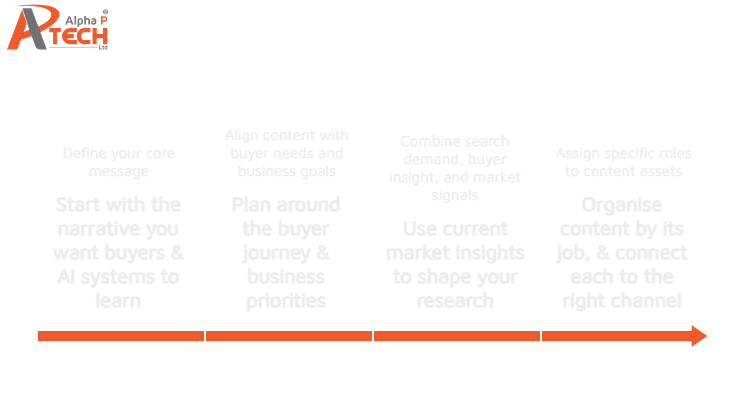
At Alpha P Tech, we use a simple content strategy built around four connected steps: define the narrative, map the buyer journey and business priority, gather the right planning signals, and assign each asset a clear job across channels. This makes content more commercially accountable and GEO-optimised.
Step 1: Start with the narrative you want buyers and AI systems to learn
Strong B2B content marketing starts by deciding what buyers and AI systems should consistently learn about your business. Before you plan topics, channels, or formats for a wider content marketing strategy, you need a clear commercial narrative.
That means defining:
- your point of view,
- what you want to be known for,
- the method behind your work,
- the expertise that supports it, and
- the difference that makes you worth choosing.
Without that foundation, your website says one thing, LinkedIn says another, and your articles pull in a different direction, which makes AI search optimisation harder because AI systems absorb an inconsistent picture.
A content plan is only as strong as the human thinking behind it. AI can rephrase average material, but it cannot decide what credible story your market should keep hearing. Narrative matters because it shapes both buyer understanding and AI understanding over time.
Step 2: Plan around the buyer journey and business priority, not just topics
Next, map the content to the buyer journey and to the services, packages, or funnels the business actually wants to grow. The key planning questions for buyer- and AI-search-optimised content are simple: what does the buyer still need to understand, believe, and validate at each stage, and which offer is that content meant to support?
That means planning content across awareness, consideration, and decision, then linking each stage to a real business priority. If Service A matters this quarter, build content that helps buyers discover the issue, understand what good looks like, and feel ready to evaluate that offer. Do the same for Service B or any other funnel you want to strengthen. At a minimum, each priority offer should have one awareness stage piece, one consideration stage piece, and one decision stage piece around it.
This is where a content plan becomes commercially accountable. Instead of producing general brand content that performs in isolation, you create B2B content marketing that supports what the business actually wants to sell and what the buyer still needs to believe before they are ready to buy.
Step 3: Build the plan from three inputs, not just keyword research
Once you plan the buyer journey and business priorities, look at the market conversations and signals, not just the keyword being used. The most useful B2B content marketing plans combine search demand, buyer and sales insight, and market conversation signals, so content is shaped by both discoverability and real buying behaviour.
- Start with search demand by looking at keyword research, Google search behaviour, and the way people phrase questions in AI search.
- Then add buyer and sales insight, including sales questions, objections, FAQs, hesitations, buying criteria, and the friction that keeps showing up in real conversations.
- Finally, look at market conversation signals such as LinkedIn themes, industry discussions, comment sections, podcasts, communities, forums, and repeated AI prompts.
This gives you a much stronger base for Generative Engine Optimisation and AI search optimisation because the plan reflects not just what people search for, but what they need to understand before they are ready to act.
Step 4: Plan content by job, then connect each job to the right channel
Finally, decide what each piece of content needs to do in the buying journey. Every asset should have a clear job. That job might be to
- explain a market shift,
- interpret what it means,
- compare approaches,
- prove credibility,
- answer objections,
- reduce perceived risk, or
- move the buyer closer to a decision.
Once that job is clear, the right format and channel become much easier to choose. This is where your content strategy becomes more practical than a simple publishing calendar.
A blog article can explain and structure the issue. A LinkedIn post can sharpen the point of view. Mentions on Reddit, Quora, and niche forums can reinforce trust for both buyers and AI systems. A case study can prove the method in action. A service page can convert informed demand once the buyer already understands the context.
The point is not to build separate mini-strategies for every channel. It is to create one connected system across your website, social media, AI search presence, and sales touchpoints. That is what makes Generative Engine Optimisation and AI search optimisation more commercially useful. The real goal is coherence, not content volume, so each touchpoint strengthens the same narrative instead of competing with it.
What a strong B2B content service should actually include
When planning your content strategy, either in-house or with an external partner, ensure the team does far more than hand over content ideas, posting schedules, or keyword lists. Good strategic support should define the narrative you want the market to learn, map content to the buyer journey, align it with the offers or funnels you want to grow, prioritise the right topics, and clarify the role each asset needs to play across the funnel.
They should also coordinate channels so your website, social media presence, AI search presence and wider B2B content marketing reinforce the same commercial story rather than pulling in different directions.
That matters because content does not just need to attract attention. It needs to support visibility, strengthen trust, qualify demand, and help buyers move towards conversion. Whether the goal is stronger Generative Engine Optimisation, better AI search optimisation, or a more effective content marketing strategy overall, the real value comes from having a plan that connects discoverability with decision-making.
Conclusion: A content plan should move buyers forward, not just keep marketing busy
Content planning is no longer just a publishing tool. In modern B2B content marketing, it is how you shape what buyers and AI systems learn about your business, how trust builds across search, social, and sales touchpoints, and how people move towards the right offer. If you want stronger AI search visibility, clearer buyer progression, and a content marketing strategy tied to real business priorities, Alpha P Tech can help you plan it.
FAQs
What is a B2B content plan for AI search visibility?
A B2B content plan for AI search visibility is a buyer journey-led plan that shapes what buyers and AI systems repeatedly learn about your business across search, social media, website content, and sales touchpoints. It goes beyond a content calendar by connecting each piece of content to a clear narrative, a business priority, and a role in moving the buyer towards a decision.
How is this different from a traditional content marketing strategy?
A traditional content marketing strategy often focuses on keywords, topic clusters, formats, and publishing frequency. That can help with consistency, but it does not always improve trust, lead quality, or sales momentum. A stronger approach starts with the commercial narrative, maps content to the buyer journey and the offers you want to grow, and plans each asset around the job it needs to do.
How do you plan content for AI search, social media, and buyers at the same time?
Start by deciding what you want the market to understand about your brand. Then map content to awareness, consideration, and decision stages around the services or funnels you want to support. From there, choose the right channel for each job. A blog article might explain the issue, a LinkedIn post might sharpen your point of view, and a service page might convert informed demand. The goal is one connected system, not separate plans for each channel.