
TL;DR: Key Takeaways for AI Search Visibility
- Good content is still the foundation: Effective GEO (Generative Engine Optimisation) is not a “trick”; it depends on clear writing, useful structure, and addressing relevant questions that guide people through the buyer’s journey.
- Prioritise Information Gain: To avoid being ignored by AI that can easily rephrase average content, you must provide unique value such as sharper points of view, practical examples, or original synthesis, rather than recycling existing summaries.
- The goal is not just reach, but movement: The best content helps buyers and AI understand the problem, the next step, and why your brand is worth remembering.
- Visibility is Shaped Across the Wider Footprint: AI visibility is shaped by your entire content ecosystem, including past PR, social media, and third-party mentions, not just a single page on your website.
- Citations Drive Authority: Brands are significantly more likely to be cited through third-party sources and earned media than through their own raw publishing volume.
- Strategic Alignment: Success requires a connected buyer journey where explainers, analysis, and thought leadership reinforce a consistent commercial story.
- The Goal is Utility: The most effective content is specific, evidence-backed, and helps the reader (and the AI) move forward with confidence.
Good GEO Starts With Good Content
If you want stronger AI search visibility, better-fit leads, and content that helps buyers move closer to a decision, the starting point is not a GEO trick. It is strong content. Answer Engine Optimisation and Generative Engine Optimisation or AI search optimisation, sit much closer to content marketing strategy than many people think, because they still depend on clear writing, useful structure, relevant questions, and pages that make sense quickly.
We’re already seeing this in practice. When we ask prospects who reach out how they found us, more are saying they came across our articles and insights through LLM citations, rather than sales pages. That matters because many people now use prompts that actively filter out promotional content and ask for independent explanations, practical guidance, or useful comparisons instead of product or service recommendations.
In that respect, a lot of the fundamentals are familiar. Good SEO and content writing have always rewarded clarity and usefulness. What has shifted is how people search, compare, and evaluate. Search journeys are now longer, more conversational, and more layered, which means your content has to do more than bring in a click. It has to help both human readers and AI systems understand what you do, why it matters, and why you are worth trusting.
That is why the real goal is not just content that can be extracted easily, but content that is worth citing, worth remembering, and strong enough to support the wider buyer journey, as explored in Is SEO Still Enough?
What Good Content Looks Like in AI Search
What makes content worth citing in AI search?
Good content in AI search is not just content that looks tidy on the page. It is content that helps someone understand a situation, make sense of their options, and move forward with more confidence.
That is where Google’s guidance on succeeding in AI Search, Google’s helpful content guidance, Bing’s article on grounding on the AI web, and Microsoft’s guidance on inclusion in AI Search answers point in the same direction. They are not really asking brands to invent a completely new kind of writing. They are pushing for content that is genuinely useful, clearly expressed, grounded in something real, and easy to interpret. The less obvious part is what that means in practice.
It means your content needs to add information gain. In simple terms, that means giving the reader and AI something more than a recycled summary of what is already out there. It could be a clearer explanation, a sharper point of view, a practical example, a stronger synthesis, or a more commercially useful interpretation of the issue. Creating that kind of content consistently is less about formatting tricks and more about process, which is explored in How to Build a B2B Content Plan for AI Search Visibility, Social Media, and Sales Momentum.
“If your content sounds like five competitors and Wikipedia, then why would AI recommend you?”
Alexandros Papantoniou, Founder, Alpha P Tech
What Does Original Value Look Like in GEO content?
That matters more now because AI can absorb and rephrase average content very easily. If your article only repeats common advice, there is less reason for it to be cited, remembered, or surfaced. Stronger content also needs to reflect the fact that visibility now includes answers, citations, reasoning, and outcomes, not just rankings.
So instead of stopping at what a topic is, the page should help people understand what the real problem is, what matters next, what trade-offs they should think about, and what step to follow next.
That is also why narrative has become part of visibility. If AI tools are summarising and comparing brands, then the terminology, point of view, and commercial story repeated across your content start shaping how your business is described. The brands that benefit most from AI search visibility will not just be the ones with neat formatting. They will be the ones whose content teaches a recognisable, credible story that buyers can believe in.
Why One Good Page Is Not Enough Anymore
AI search visibility is shaped by your wider content footprint, not just one page on your website. That is one of the most commercially important ideas in GEO and AEO. As Cision’s analysis of branded prompts shows, buyers and AI systems are often learning about your brand through an accumulated trail of signals across PR, social content, owned media, expert commentary, and third-party coverage, both old and new, not only through the page you most want them to see.
If the goal is to become included, quoted, and trusted in generative search, then every part of your content marketing strategy starts carrying more weight, including older posts, articles, mentions, and narratives you published over time.
The wider research points in the same direction. Ahrefs’ study on AI brand visibility found that branded web mentions were far more closely linked to AI visibility than raw publishing volume. AirOps’ report on offsite signals found that brands were 6.5 times more likely to be cited through third-party sources, while 85% of brand mentions came from external domains. Omniscient’s analysis of how LLMs source brand information reached a similar conclusion, with earned media accounting for 48% of citations in branded prompts.
Taken together, the message for AI search optimisation is bigger than writing one strong article. It is about planning a recognisable, credible story across your full content ecosystem. This is how one building materials supplier boosted traffic and brand mentions. As discussed in GEO: Real World Examples of How Brands Are Winning AI Search, by restructuring their content marketing strategy around customer questions, and strengthening credibility in industry publications, Reddit and YouTube, they increased organic traffic by 67%, traffic value by 400% and Google AI Overview mentions by 540%.
How to Plan Content That Supports Buyers, GEO, and Thought Leadership
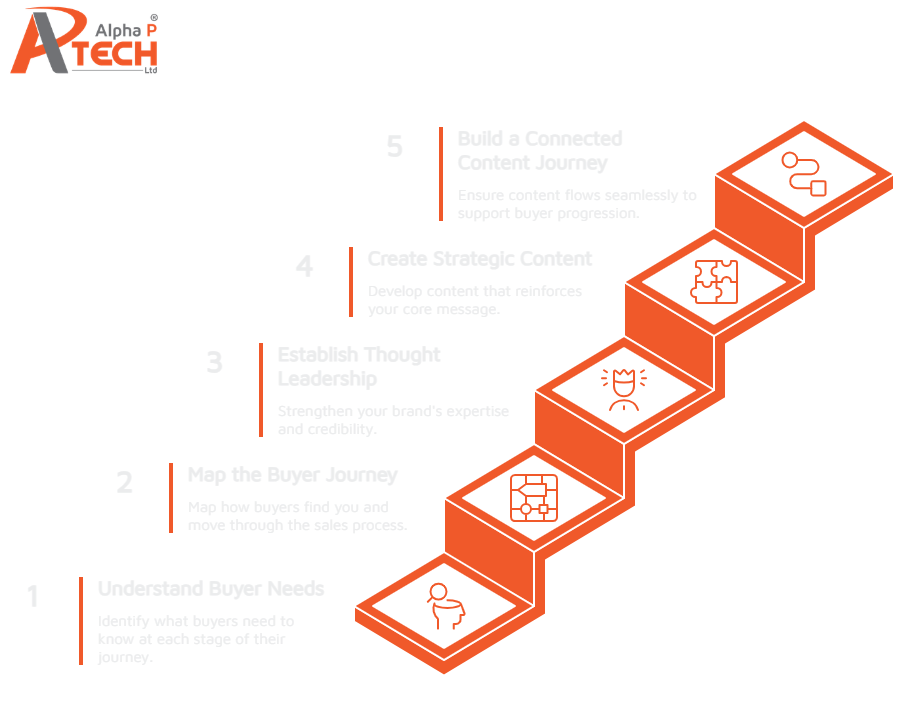
That broader footprint changes what good planning needs to do. If buyers and AI systems are forming an understanding of your brand across multiple touchpoints, then your content marketing strategy has to become more deliberate about what the market learns, when it learns it, and how each piece supports the next.
That is where strategic content planning, buyer journey planning, and thought leadership start to work best together. Good planning begins by deciding what buyers need to understand at the awareness, consideration, and decision stages, which questions matter most at each point, and which gaps in the journey are slowing trust, weakening belief, or delaying revenue opportunities.
Thought leadership adds real value when it strengthens your point of view, sharpens your proof, and helps the market interpret the issue more clearly, rather than simply adding more opinion for the sake of visibility.
Strategic content is what joins that thinking up across the journey, with explainers, analysis, commentary, proof, and comparison, each reinforcing the same commercial story from different angles. This way, buyers and AI systems come away with a clearer and more consistent understanding of what you do and why it matters.
Seen that way, the question for SEO and content teams becomes less about what content to publish, and more about how to build a connected content journey that supports visibility, trust, and deal momentum. Practically, that means thinking beyond simply filling a content calendar with articles, whitepapers, and other assets, and considering what prospects need at each stage of the funnel to move through the buyer journey with more clarity and confidence. A useful next step is How to Build a B2B Content Plan for AI Search Visibility, Social Media, and Sales Momentum, which explores how that thinking can be applied more deliberately across the buyer journey.
The best content is written for AI search AND buyers, and gives both something worth repeating – Alexandros Papantoniou, Founder, Alpha P Tech
Conclusion: The Best GEO Content Gives Buyers and AI Something Worth Repeating
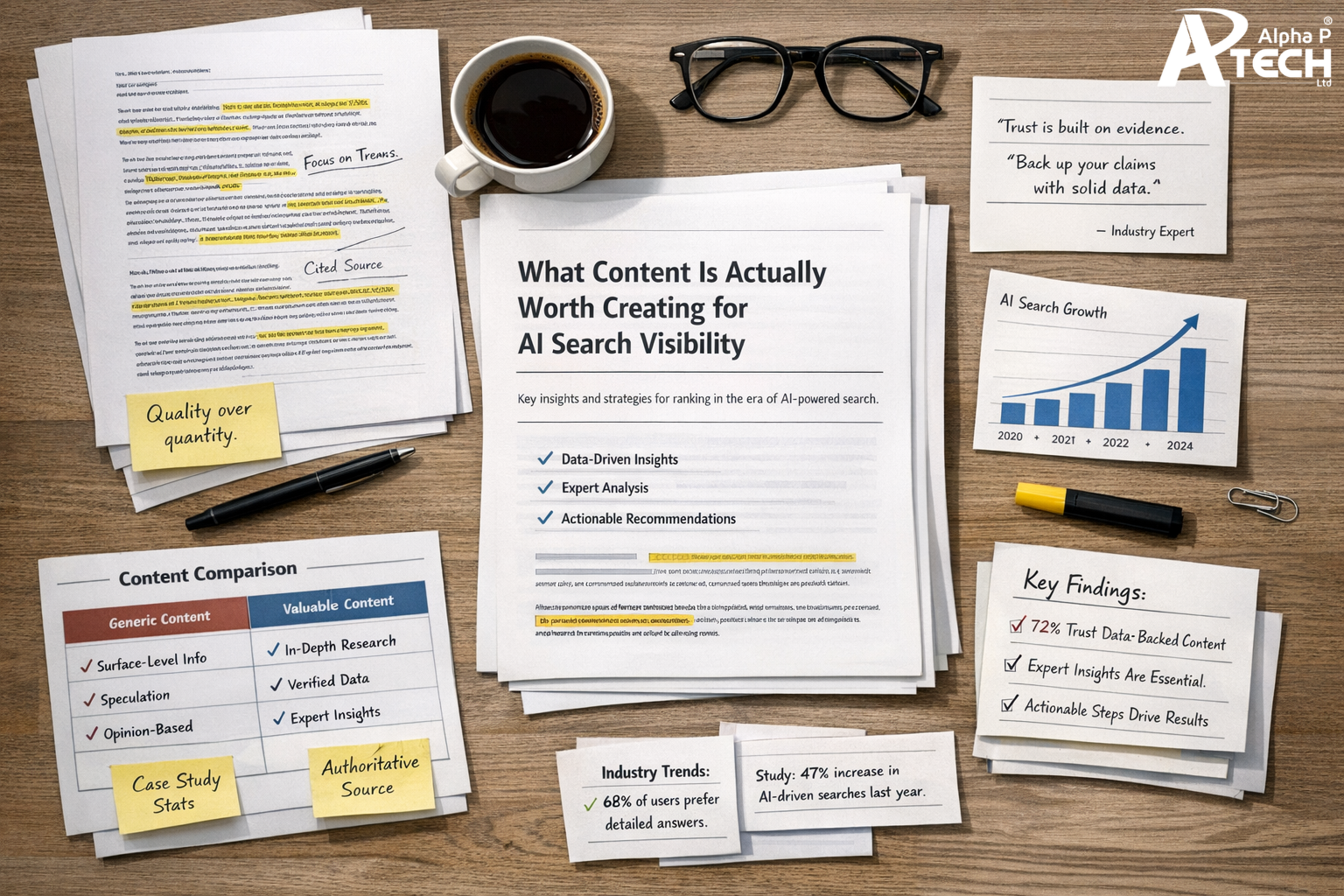
What content is actually worth creating for AI search visibility? The answer is content that is useful, specific, supported by evidence, strategically planned, and shaped around real buyer needs.
Strong Generative Engine Optimisation and AEO still depend on clear structure and readability, but those things only do their job well when the thinking behind the content is strong. A neatly formatted page on its own does not create meaningful visibility, trust, or commercial movement.
What makes the difference is the combination of strategic planning, strong content, and thought leadership, because together they help both people and AI systems form a clearer and more memorable understanding of your brand.
In that sense, AI search optimisation is not pulling content marketing strategy away from the fundamentals. It is pushing it back towards the things that matter most: better audience understanding, better planned journeys, stronger points of view, and content that genuinely helps someone move forward.